
The Process Of Solar Panel Manufacturing

Solar energy is becoming a popular and sustainable alternative to traditional energy sources. With the growing demand for clean energy, the need for solar panels is also increasing. These panels are essential for capturing and converting sunlight into electricity.
Key Components Of A Solar Panel

A solar panel, also known as a photovoltaic (PV) panel, turns sunlight into electricity. This process is called the photovoltaic effect. Solar panels are key to renewable energy technology. They help us capture clean and sustainable power from the sun.
Each solar panel contains many small units called solar cells, or photovoltaic cells. These cells are connected to form a module. Each solar cell is made from materials like crystalline silicon. These materials absorb photons, which are particles of light, and change their energy into electrical current.
The design of a solar panel involves several key components:
Solar Cells
Solar cells are the building blocks of a solar panel. When exposed to sunlight, the photons interact with the semiconducting material. It causes the release of electrons and generates an electric current. Silicon-based solar cells are the most widely used due to their efficiency and stability.
Encapsulation
They are encapsulated in a protective layer to protect the solar cells from environmental factors and ensure durability. This layer is usually made of ethylene-vinyl acetate (EVA) and a tempered glass cover. The encapsulation shields the cells from moisture, dust, and mechanical stress.
Backsheet
The backsheet is a layer on the solar panel’s rear side. It acts as an electrical insulator and protects against humidity and potential damage.
Frame
Solar panels are typically surrounded by a sturdy frame made of aluminium or steel. The structure provides structural support, facilitates installation, and protects the board’s edges.
Junction Box
A junction box is attached to the back of a solar panel. It houses electrical connectors and protects the wiring from weather. This box helps connect multiple panels and allows the generated electricity to flow.
When sunlight hits the solar panel, photons (light particles) pass through the glass cover and reach the solar cells. The semiconducting material in the cells absorbs the photons, freeing electrons from their atoms. These freed electrons flow, creating direct current (DC) electricity.
To use this electricity in homes or businesses, we need an inverter. The inverter changes the DC electricity from the solar panel into alternating current (AC), which is the type of electricity used in most electrical systems.
We often install solar panels on rooftops, in open fields, or in any sunny area. We can connect panels in series or parallel to increase voltage or current. When we connect many solar panels, we create a solar array. This array can generate large amounts of electricity.
Overview Of Solar Panel Manufacturing
Solar panel manufacturing involves a multi-step process that transforms raw materials into functional solar panels capable of harnessing the sun’s power.
Step 1: Silicon Ingot Production
Producing silicon ingots is a critical first step in making solar panels. It starts with extracting metallurgical-grade silicon by reducing quartz with carbon in an electric arc furnace. This process yields silicon, which is then refined into high-purity polysilicon.
Next, the refined polysilicon is melted in a quartz crucible using a specialized furnace, like an induction or resistance furnace, to form ingots. The molten silicon is carefully kept at a precise temperature to ensure optimal crystal growth. A seed crystal, usually made of single-crystal silicon, is dipped into the molten silicon and slowly pulled out, allowing a single crystal to form around it.
The pulling process is carefully controlled to achieve the desired crystal structure and minimize defects. The silicon ingot grows cylindrical, with its size determined by its intended use. Once the crystal reaches the right size, it’s cooled and removed from the crucible.
After extraction, the silicon ingots go through several steps to become wafers for solar cells. These include slicing the ingot into thin pieces with wire saws, grinding and polishing them for a smooth surface, and etching and cleaning to remove impurities and prepare them for making solar cells.
Producing silicon ingots demands precise control over temperature, crystal growth, and purification techniques. These ingots are essential for solar panels, enabling efficient and reliable conversion of solar energy into electricity.
Step 2: Wafer Production

Wafer production is a critical step in making solar panels. It transforms silicon ingots into the key components of solar cells. First, silicon ingots are sliced into thin wafers using wire saws. These saws use diamond-coated wires to ensure precise cuts with minimal material loss.
After cutting, the wafers are ground and polished to create smooth, uniform surfaces. This removes saw marks and irregularities, ensuring consistent thickness and flatness. Multiple grinding and polishing stages are used to achieve the desired quality.
Next, the wafers are thoroughly cleaned to remove any contaminants. Chemical treatments and rinsing with deionized water are used to achieve high cleanliness levels.
The cleaned wafers undergo inspection to detect defects. Visual checks and automated scanning are used to identify and discard wafers that don’t meet standards.
The final step in wafer production is doping. This involves adding specific impurities to the wafers to adjust their electrical properties. This step is crucial for creating p-n junctions in the solar cells, which enable the conversion of sunlight into electricity.
Step 3: Solar Cell Creation
Creating solar cells is a crucial step in making solar panels. It involves precise procedures to turn wafers into functional devices that convert sunlight into electricity.
First, an anti-reflective coating is applied to the front surface of the wafer. This coating reduces light reflection and boosts light absorption, making the solar cell more efficient.
Next, doping creates regions of positive (p-type) and negative (n-type) conductivity within the wafer. Specific impurities are added using diffusion or ion implantation techniques. This creates a p-n junction that separates and directs charge carriers when sunlight hits the cell.
After doping, a grid pattern of metallic contacts is screen-printed on the wafer’s top surface. Moreover, these contacts act as electrical paths, allowing charge carriers to be collected and sent to external circuits.
A layer of passivation material is then applied to both sides of the wafer to reduce surface recombination and improve cell performance.
To finish the solar cell, a transparent conductive layer like indium tin oxide (ITO) is deposited on the front surface. This layer allows sunlight to pass through while enabling the extraction of electricity.
Finally, the solar cells undergo testing to ensure they meet quality and performance standards.
Step 4: Solar Cell Interconnection

Interconnecting solar cells is a crucial step in making solar panels. It involves joining individual cells to create an efficient photovoltaic module, focusing on both electrical connections and panel structure.
First, they align solar cells and position them in a specific matrix, with their electrical contacts exposed for interconnection.
The main method used is tabbing and stringing. They solder thin copper ribbons, called tabbing ribbons, onto the front and back contacts of the cells. Also, these ribbons connect adjacent cells, ensuring smooth current flow and minimizing power loss.
After tabbing, they solder thicker stripes called busbars onto the tabbing ribbons. These busbars create pathways for current to flow across the entire panel, efficiently collecting and transmitting electricity.
To strengthen the panel and protect it from environmental factors, an encapsulant material like ethylene-vinyl acetate (EVA) is applied over the interconnected cells. This layer shields the cells from moisture and physical stress while allowing sunlight to pass through.
Finally, they add a back sheet made of durable materials like Tedlar to the rear surface of the panel. This back sheet provides additional protection and electrical insulation, ensuring the panel’s long-term performance and reliability.
Step 5: Encapsulation
Encapsulation is a crucial step in making solar panels, protecting the cells from environmental damage and ensuring long-term durability. This process involves applying layers that shield the solar cells and components from moisture, temperature changes, impacts, and UV rays.
First, we use a back sheet material. It acts as a moisture barrier and provides electrical insulation. Typically made of materials like Tedlar or EVA, this layer protects the rear of the panel from water and humidity.
Next, we apply an encapsulant material, usually EVA, over the front surface of the solar cells. It bonds the cells to the back sheet, providing structural support and enhancing sunlight transmission for better energy efficiency.
A front cover material, such as a glass or ETFE, is then added over the encapsulant layer. This material shields the cells from physical damage, weather conditions, and UV radiation.
Encapsulation ensures the solar panel is resistant to moisture, prevents electrical issues, and improves overall strength. It creates a protective barrier that allows the cells to perform reliably over time, making solar panels suitable for various applications like rooftops, solar farms, and off-grid systems.
Step 6: Module Assembly

Module assembly is a significant step in making solar panels. Here, we integrate all components, including the interconnected solar cells, encapsulation layers, and support structures, to create a complete photovoltaic module.
The process begins by placing encapsulated solar cells onto the back sheet. Next, manufacturers align and bond them securely using adhesives or lamination to ensure proper positioning and electrical connectivity.
After placing the cells, they make electrical connections between them and the module’s junction box. This box acts as the interface for transferring electricity between the solar panel and external systems. It contains diodes and connectors for safe and efficient electricity transfer.
To strengthen the module, they attach a frame or support structure around its perimeter. This frame adds stability, protects the panel edges, and makes it easier to install in different applications.
Quality checks and testing are crucial during module assembly. Electrical tests, like current-voltage measurements and insulation checks, along with thermal cycling tests, ensure the module meets performance standards and is reliable for long-term use.
Step 7: Testing And Quality Assurance
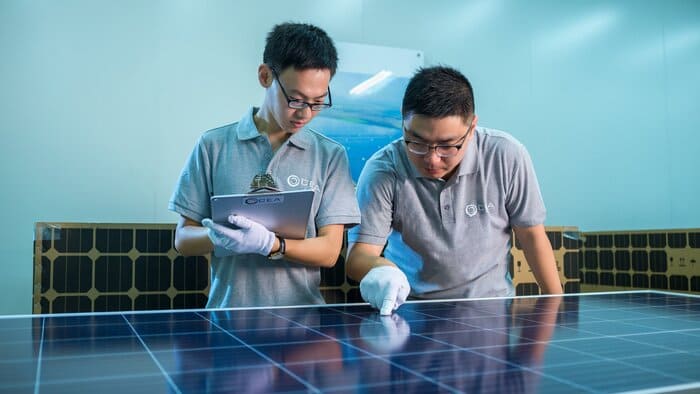
Testing and quality assurance are the final stages in making solar panels, ensuring they meet performance, reliability, and safety standards. These steps involve thorough tests and inspections to assess the panels’ functionality, efficiency, and durability before they are ready for installation.
Electrical testing is crucial. It includes measuring current-voltage curves, open-circuit voltage, short-circuit current, and maximum power output. Also, these tests evaluate how well the panels perform under different conditions and detect any deviations from expected specifications.
Insulation resistance testing checks the electrical insulation integrity within the panels to prevent potential electrical leaks or short circuits.
Furthermore, visual inspections look for physical defects like cracks or delamination in the encapsulation layers, ensuring the panels are structurally sound and free of visible flaws that could affect their performance.
Environmental testing subjects panels to simulated conditions such as temperature changes, humidity, UV exposure, and mechanical stress. These tests assess how well panels endure harsh weather and prolonged sunlight exposure without losing performance.
Quality assurance also includes verifying compliance with industry standards like the International Electrotechnical Commission (IEC) standards, ensuring panels meet requirements for performance, safety, and durability.
FAQs

- How long does it take to manufacture a solar panel? The manufacturing process typically takes several hours, but the overall duration can vary depending on the scale of production and the specific technologies used.
- What materials are used in solar panel manufacturing? Solar panels consist of silicon wafers, tempered glass, metal busbars, and polymer materials for encapsulation and back sheets.
- Are solar panels recyclable? Yes, solar panels are recyclable. Also, the materials used in their construction, like silicon and glass, can undergo recycling and reuse.
- How efficient are solar panels? The efficiency of solar panels can vary, but modern panels can convert sunlight into electricity with an efficiency of around 15% to 20%.
- Can solar panels work in cloudy weather? Solar panels can generate electricity in cloudy weather. But their output may vary compared to sunny conditions. They can still contribute to a significant portion of energy production, even on overcast days.
Conclusion
Solar panel manufacturing involves several crucial steps. It starts with producing silicon ingots to assembling and testing the panels. Moreover, each step plays a vital role in creating efficient and durable solar panels that capture solar energy. Above all, as demand for clean energy grows, solar panel manufacturing can profoundly impact our shift to a sustainable future.